Which Consumers Are Most Reluctant to Buy from Companies Using AI?
Executive Summary
A recent Empirical Intelligence survey (N=1,004 Canadian citizens) found that Canadians are more than three times as likely to say that a company's use of AI would make them less likely to buy from it than more likely. However, reactions vary considerably across demographic groups, particularly by education, and have changed little since November 2025.Key Findings
- Education is the strongest dividing line: University graduates are relatively receptive to companies using AI, while Canadians with a high school education or less are nearly 31 percentage points more likely to react negatively than positively.
- Women are more reluctant than men: Net willingness to buy from companies using AI is nearly 12 percentage points lower among women.
- Age and community matter too: Canadians aged 45 and over, as well as residents of suburban and rural communities, are more reluctant to buy from companies using AI than their younger and urban counterparts.
In a recent Empirical Intelligence pan-Canadian survey with 1,004 respondents (Canadian citizens 18+), we asked Canadians if they would be more or less likely to buy a product or service from a company after finding out that they use artificial intelligence (AI).
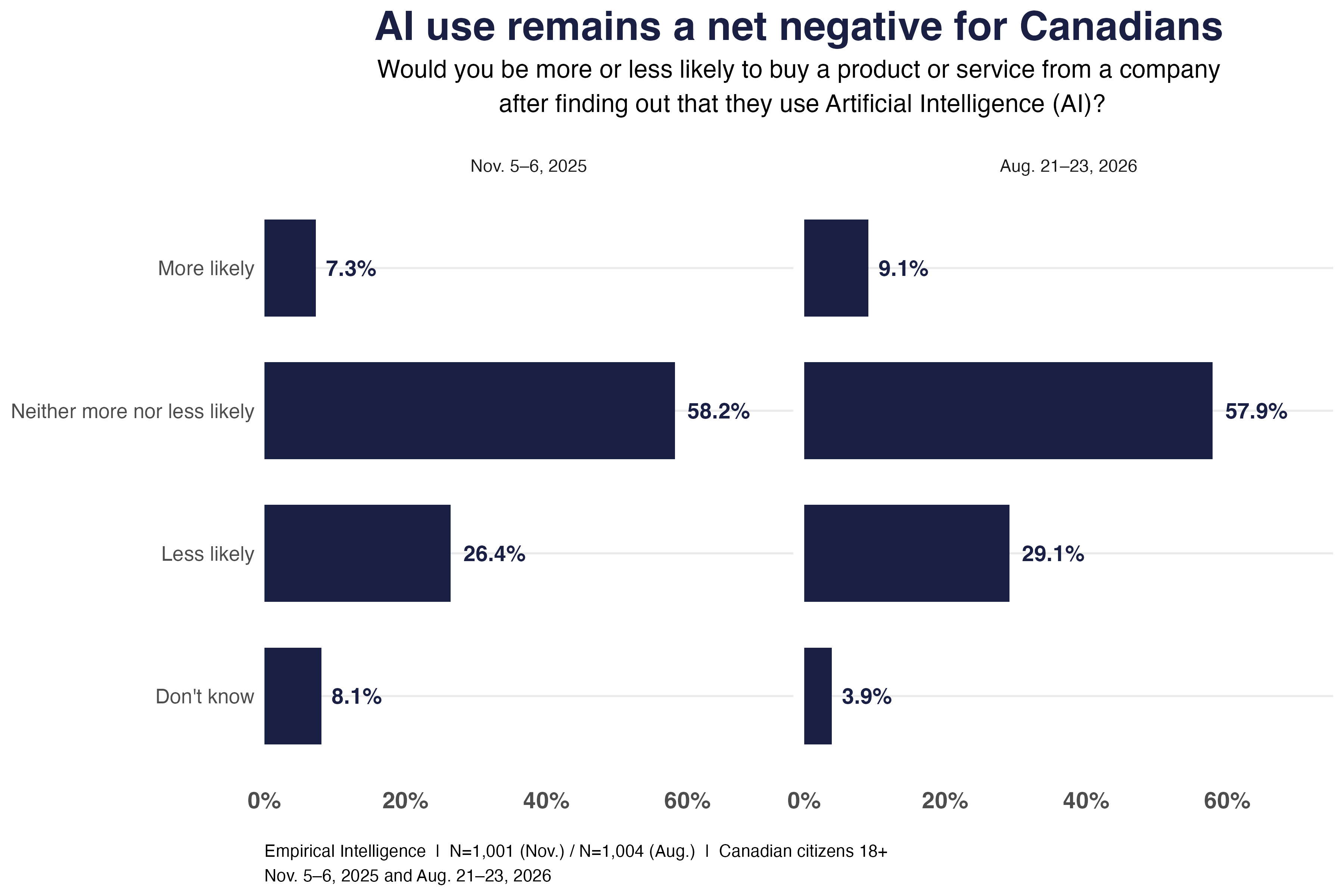
We asked the same question in a survey in November 2025. In both surveys, most Canadians said that AI use would make no difference to their purchase decisions. However, over three times more respondents said AI use would make them less likely to buy a product or service than said it would make them more likely to buy from a company.
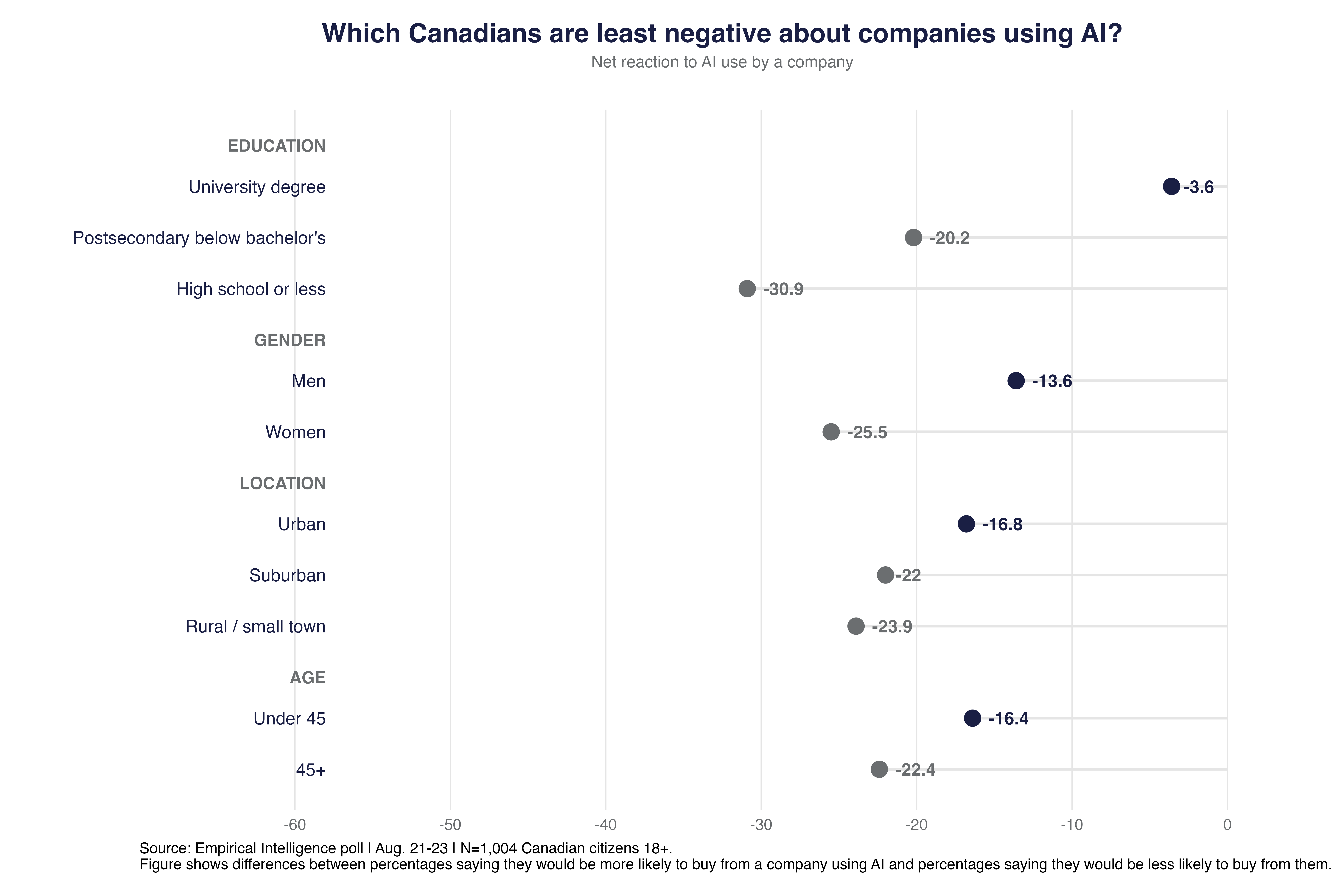
The biggest gap in AI reluctance is betweeen education groups
We then examined how reactions to AI use vary across demographic groups. We subtracted the percentage within each group who say they would be less likely to buy from a company using AI from the percentage saying they would be more likely to buy from a company using AI. Differences are negative in all segments, meaning that there are more respondents in each group who would be less likely to buy from a company using AI than there are respondents who would be more likely to buy from a company using AI.
The biggest gap by far is between education groups. Among respondents with a university degree, the difference is only -3.6. There are almost as many university graduates who would be more likely to buy from a company using AI as there are who would be less likely to buy from a company using AI. However, 20 percentage points more Canadians with postsecondary education below a bachelor’s degree say they would be less likely to buy from a company using AI than say they would be more likely to buy from them. The gap is nearly 31 points among Canadians with a high school education or less.
The next largest difference is between men and women. Net willingness to buy from companies using AI is nearly 12 points lower among women than among men. There are also smaller gaps between types of communities and between age groups. Residents of suburban and rural areas/small towns react a little more negatively to AI use than residents of urban areas. Canadians under 45 are slightly less reluctant than Canadians 45 and over to buy from companies that use AI.
AI use is still a net negative for Canadian consumers
Overall, more than three times as many Canadians say they would be less likely to buy from a company that uses AI than say they would be more likely to buy from one. However, reactions vary considerably across demographic groups. Among university graduates, almost as many say they would be more likely to buy from companies using AI as say they would be less likely to buy from them. Among Canadians with a high school education or less, the net negative reaction is nearly 31 percentage points. Women, Canadians aged 45 and over, and residents of suburban and rural communities are also more likely to react negatively than their counterparts.
Of course, these results reflect stated purchase intentions rather than actual consumer behaviour. Nevertheless, they suggest that Canadians are considerably more likely to react negatively than positively to companies' use of AI. What's particularly striking is how little these attitudes have changed since November 2025.
Companies using AI, or considering its adoption, should consider how consumers might perceive its use and whether it could affect their purchasing decisions. In particular, they should seek to understand the concerns of consumers who are most reluctant to buy from companies using AI. Research can help identify which applications of AI generate the most concern, what assurances make consumers more comfortable, and how companies can communicate their use of AI without undermining consumer confidence.
Methodology
Nov. 2025 sample: 1,001 Canadian citizens aged 18 and over, Nov. 5–6, 2025. Aug. 2026 sample: 1,004 Canadian citizens aged 18 and over, Aug. 21-23, 2026. Respondents were recruited from a variety of online panels using Cint Exchange. Results are weighted to Census benchmarks for age, gender, education, and region, and then weighted halfway toward 2025 federal election results using respondents' recalled vote. If the results were from a probability sample, the margin of error would be 3.1 percentage points, 19 times out of 20. Interviews were in English and French.